


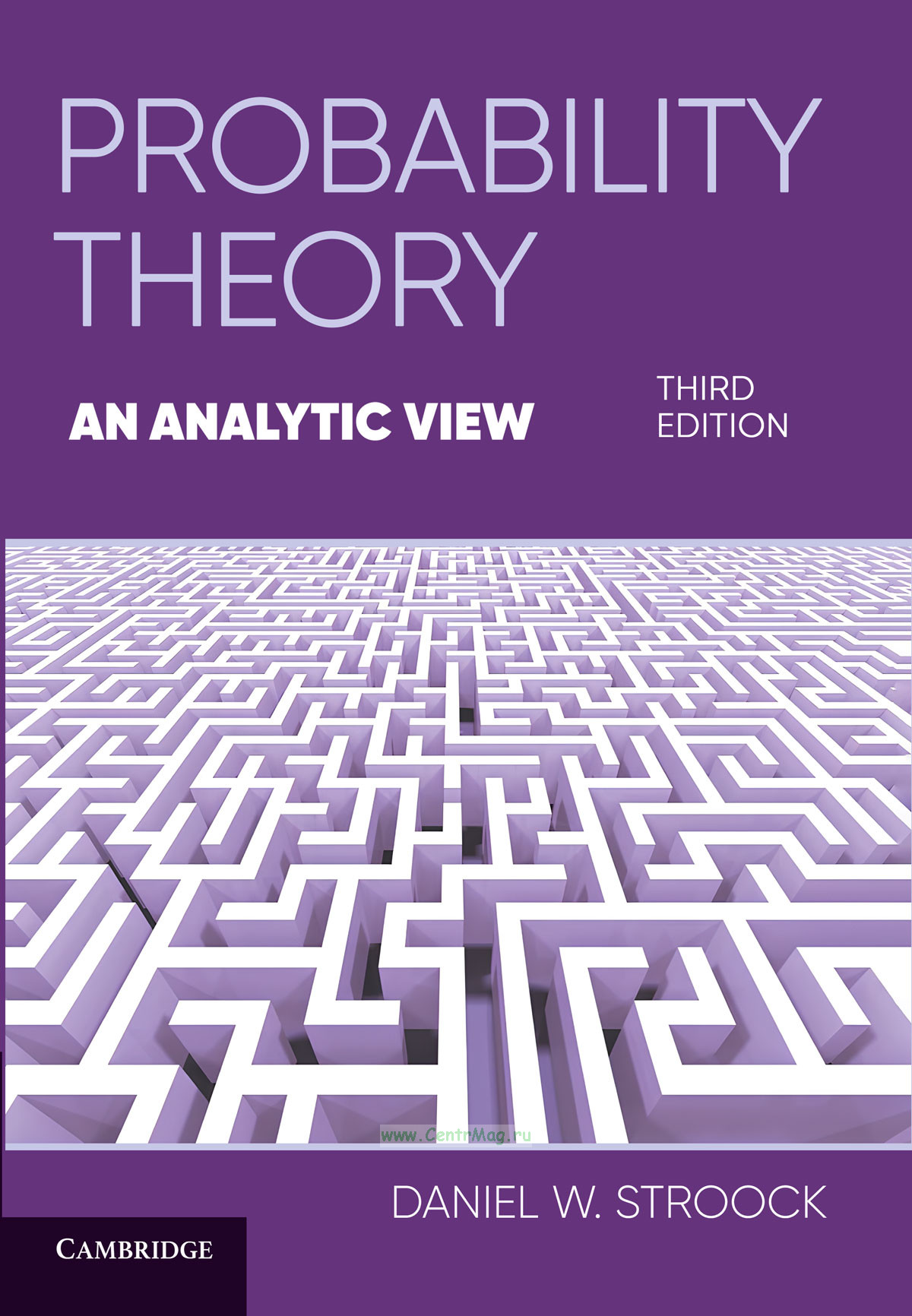
- Артикул:00-01115757
- Автор: Daniel W. Stroock
- ISBN: 978-1-009-54900-4
- Обложка: Твердая обложка
- Издательство: Cambridge University Press (все книги издательства)
- Город: Cambridge
- Страниц: 465
- Год: 2025
- Вес: 656 г
Развернуть ▼
Издание на английском языке
This book provides a comprehensive and insightful introduction to modern probability theory and its connections to analysis, differential equations, and statistics. It covers topics ranging from the fundamentals of martingales and their properties to extensions of the theory to infinite-dimensional and Banach spaces, and also explores Brownian motion, Gaussian measures, and their structural properties. Key theorems, such as the convergence theorem, De Fierden's theorem, the Birkland-Inequality theorem, and other important results are examined, supported by rigorous proofs. Particular attention is paid to the application of probabilistic methods to differential equations, analytical problems, and potentials, demonstrating how probability theory interacts with classical mathematics. The book contains practical recommendations for organizing a course and offers readers additional resources for in-depth study.
It is intended for graduate students, teachers, and specialists seeking a comprehensive understanding of the current state of probability theory and its applications.
Content
Preface page
Notation
1. Sums of Independent Random Variables
1.1. Independence
1.1.1. Mutually Independent - Algebras
1.1.2. Mutually Independent Functions
1.1.3. The Rademacher Functions
1.1.4. Exercises for §1.1
1.2. The Weak Law of Large Numbers
1.2.1. Orthogonal Random Variables
1.2.2. Mutually Independent Random Variables
1.2.3. Approximate Identities
1.2.4. Exercises for §1.2
1.3. Cramer's Theory of Large Deviations
1.3.1. Exercises for §1.3
1.4. The Strong Law of Large Numbers
1.4.1. Exercises for §1.4
1.5. The Law of the Iterated Logarithm
1.5.1. Exercises for §1.5
2. The Central Limit Theorem
2.1. The Basic Central Limit Theorem
2.1.1. Lindeberg's Theorem
2.1.2. The Central Limit Theorem
2.1.3. Exercises for §2.1
2.2. The Berry-Esseen Theorem via Stein's Method
2.2.1. L1 -Berry-Esseen
2.2.2. The Classical Berry-Esseen Theorem
2.2.3. Exercises for §2.2
2.3. Some Extensions of the Central Limit Theorem
2.3.1. The Fourier Transform
2.3.2. Multidimensional Central Limit Theorem
2.3.3. Higher Moments
2.3.4. Exercises for §2.3
2.4. An Application to Hermite Multipliers
2.4.1. Hermite Multipliers
2.4.2. Beckner's Theorem
2.4.3. Applications of Beckner's Theorem
2.4.4. Exercises for §2.4
3. Infinitely Divisible Laws
3.1. Convergence of Measures on R
3.1.1. Sequential Compactness in M1 (RN)
3.1.2. Levy's Continuity Theorem
3.1.3. Exercises for §3.1
3.2. The Levy-Khinchine Formula
3.2.1. I(RN) Is the Weak Closure of P(RN)
3.2.2. The Formula
3.2.3. Exercises for §3.2
3.3. Stable Laws
3.3.1. General Results
3.3.2. a-Stable Laws
3.3.3. Exercises for §3.3
4. Levy Processes
4.1. Stochastic Processes, Some Generalities
4.1.1. The Space D (RN)
4.1.2. Jump Functions
4.1.3. Exercises for §4.1
4.2. Discontinuous Levy Processes
4.2.1. The Simple Poisson Process
4.2.2. Compound Poisson Processes
4.2.3. Poisson Jump Processes
4.2.4. Levy Processes with Bounded Variation
4.2.5. General, Non-Gaussian Levy Processes
4.2.6. Exercises for §4.2
4.3. Brownian Motion, the Gaussian Levy Process
4.3.1. Deconstructing Brownian Motion
4.3.2. Levy's Construction of Brownian Motion
4.3.3. Kolmogorov's Continuity Criterion
4.3.4. Brownian Paths Are Nondifferentiable
4.3.5. General Levy Processes
4.3.6. Exercises for §4.3
5. Conditioning and Martingales
5.1. Conditioning
5.1.1. Kolmogorov's Definition
5.1.2. Some Extensions
5.1.3. Exercises for §5.1
5.2. Discrete Parameter Martingales
5.2.1. Doob's Inequality and Marcinkewitz's Theorem
5.2.2. Doob's Stopping Time Theorem
5.2.3. Martingale Convergence Theorem
5.2.4. Reversed Martingales and De Finetti's Theory
5.2.5. Exercises for §5.2
6. Some Extensions and Applications of Martingale Theory
6.1. Some Extensions
6.1.1. Martingale Theory for a ^-Finite Measure Space
6.1.2. Banach Space-Valued Martingales
6.1.3. Exercises for §6.1
6.2. Burkholder's Inequality
6.2.1. Burkholder's Comparison Theorem
6.2.2. Burkholder's Inequality
6.2.3. Exercises for §6.3
6.3. Elements of Ergodic Theory
6.3.1. The Maximal Ergodic Lemma
6.3.2. Birkhoff's Ergodic Theorem
6.3.3. Ergodic Decomposition
6.3.4. Unique Ergodicity
6.3.5. Stationary Sequences
6.3.6. Continuous Parameter Ergodic Theory
6.3.7. Exercises for §6.3
7. Continuous Parameter Martingales
7.1. Continuous Parameter Martingales
7.1.1. Progressively Measurable Functions
7.1.2. Martingales: Definition and Examples
7.1.3. Basic Results
7.1.4. Stopping Times and Stopping Theorems
7.1.5. An Integration by Parts Formula
7.1.6. Exercises for §7.1
7.2. Brownian Motion and Martingales
7.2.1. Levy's Characterization of Brownian Motion
7.3. Doob-Meyer Decomposition, an Easy Case
7.3.1. Burkholder's Inequality Again
7.3.2. Exercises for §7.2 and §7.3
7.4. The Reflection Principle Revisited
7.4.1. Reflecting Symmetric Levy Processes
7.4.2. Reflected Brownian Motion
7.4.3. Exercises for §7.4
8. Gaussian Measures on a Banach Space
8.1. The Classical Wiener Space
8.1.1. Classical Wiener Measure
8.1.2. The Classical Cameron-Martin Space
8.1.3. Exercises for §8.1
8.2. A Structure Theorem for Gaussian Measures
8.2.1. Fernique's Theorem
8.2.2. The Basic Structure Theorem
8.2.3. The Cameron-Martin Space
8.2.4. Exercises for §8.2
8.2.5. The Ornstein-Uhlenbeck Process
8.2.6. Ornstein-Uhlenbeck as an Abstract Wiener Space
8.3. Wiener's Construction of Abstract Wiener Space
8.3.1. Wiener Series
8.3.2. Pinned Brownian Motion
8.3.3. Orthogonal Invariance
8.3.4. Exercises for §8.3
8.4. The Gaussian Isoperimetric Inequality
8.4.1. Strassen's Law of the Iterated Logarithm
8.4.2. Exercises for §8.4
9. Convergence of Measures on a Polish Space
9.1. Prohorov-Varadarajan Theory
9.1.1. Some Background
9.1.2. The Weak Topology
9.1.3. The Levy Metric and Completeness of M1 (E)
9.1.4. Kolmogorov's Consistency Theorem
9.1.5. Exercises for §9.1
9.2. Regular Conditional Probability Distributions
9.2.1. Fibering a Measure
9.2.2. Representing Levy Measures via the Ito Map
9.2.3. Exercises for §9.2
9.3. Donsker's Invariance Principle
9.3.1. Donsker's Theorem
9.3.2. Rayleigh's Random Flights Model
9.3.3. Exercises for §9.3
10. Wiener Measure and Partial Differential Equations
10.1. Martingales and Partial Differential Equations
10.1.1. Localizing and Extending Martingale Representations
10.1.2. The Minimum Principles
10.1.3. The Hermite Heat Equation
10.1.4. The Arcsine Law
10.1.5. Recurrence and Transience of Brownian Motion
10.1.6. Exercises for §10.1
10.2. The Markov Property and Potential Theory
10.2.1. The Markov Property for Wiener Measure
10.2.2. Recurrence in One and Two Dimensions
10.2.3. The Dirichlet Problem
10.2.4. Exercises for §10.2
10.3. Other Heat Kernels
10.3.1. A General Construction
10.3.2. The Dirichlet Heat Kernel
10.3.3. Feynman-Kac Heat Kernels
10.3.4. Ground States and Associated Measures on Pathspace
10.3.5. Producing Ground States
10.3.6. Exercises for §10.3
11. Some Classical Potential Theory
11.1. Uniqueness Refined
11.1.1. The Dirichlet Heat Kernel Again
11.1.2. Exiting through dreG
11.1.3. Applications to Questions of Uniqueness
11.1.4. Harmonic Measure
11.1.5. Exercises for §11.1
11.2. The Poisson Problem and Green's Functions
11.2.1. Green's Functions when N > 3
11.2.2. Green's Functions when N э{1,2}
11.2.3. Exercises for §11.2
11.3. Excessive Functions, Potentials, and Riesz Decompositions
11.3.1. Excessive Functions
11.3.2. Potentials and Riesz Decomposition
11.3.3. Exercises for §11.3
11.4. Capacity
11.4.1. The Capacitory Potential
11.4.2. The Capacitory Distribution
11.4.3. Wiener's Test
11.4.4. Asymptotic Expressions Involving Capacity
11.4.5. Exercises for §11.4
References
Index
5.0
Пока нет отзывов. Будьте первым, кто оставит отзыв.